
When people talk about peptide side effects, the conversation usually gets reduced to one simple question: Is this peptide causing the problem? At Revive, we look at it differently.
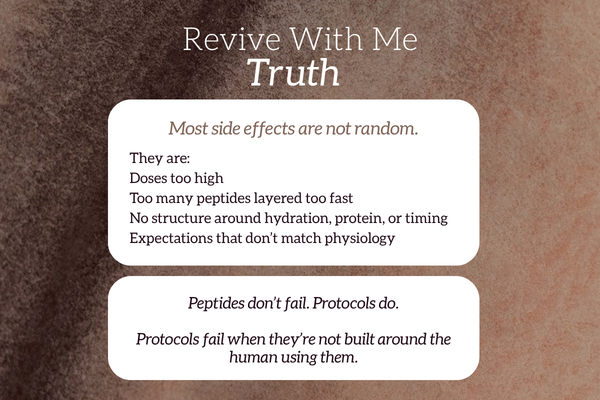
Most side effects are not random. They are usually signals. Signals that dosing may be too high, timing may be off, too many compounds were layered too quickly, or the body does not have the support it needs to respond well. That matters because peptides do not fail in isolation. Protocols fail when they are not built around the human using them.
A better approach starts with understanding what is actually happening in the body, why certain effects show up, and how to adjust intelligently instead of assuming that discomfort means something is “not working.”
What Side Effects Are Actually Telling You
Many peptide side effects are predictable once you understand the physiology behind them. In most cases, they come back to a few core issues:
- The dose is too high
- Too many peptides are layered too fast
- Hydration, protein, and timing are not structured well
- Expectations do not match how the body actually adapts
This is why education matters. A peptide may be doing exactly what it is designed to do, but if the protocol is poorly timed, aggressively stacked, or unsupported by the basics, the experience can still go sideways.
At Revive, we do not treat symptoms like random inconveniences. We look at the mechanism, the timing, the recovery environment, and the person as a whole. That is why it is more useful to ask: What is this side effect telling me? Instead of simply asking, Is this peptide bad for me?
The Foundational Drivers Behind Better Peptide Outcomes
Before looking at specific peptides, it is important to understand the factors that shape how someone responds to any protocol. These foundations influence tolerance, recovery, and results more than most people realize.
Protein builds the result
Many peptides influence repair, muscle preservation, metabolic output, recovery signaling, or appetite regulation. None of that works well if the body does not have the raw materials it needs.
If protein intake is too low, the body is working with incomplete inputs. That can show up as poor recovery, fatigue, difficulty holding onto muscle, or a mismatch between expectations and results.
Sleep drives repair
A large part of peptide success depends on what the body is already primed to do during rest. Recovery, immune regulation, tissue remodeling, and growth signaling all depend on sleep quality.
When sleep is poor, repair is poor. When repair is poor, protocols often feel harsher than they should.
Stress blocks outcomes
High stress changes the internal environment. It can disrupt hunger cues, energy stability, blood sugar regulation, sleep quality, fluid balance, and recovery.
This is one reason two people can take the same protocol and have very different experiences.
Timing matters
Timing is not just a convenience issue. It changes how a peptide feels, how it integrates into daily rhythm, and how well someone tolerates it.
Some compounds are better earlier in the day because they increase energy turnover or create a more stimulated feeling. Others fit better at night when the goal is repair, recovery, or alignment with natural hormone pulses.

GLP-1s: Why Appetite Suppression Still Needs Structure
GLP-1s like semaglutide, tirzepatide, and retatrutide can be powerful tools, but they also come with common patterns that need to be understood. Nausea, constipation, fatigue, reduced appetite, and dehydration are among the most common concerns.
These effects are often tied to slowed gastric emptying, blood sugar stabilization, and shifts in appetite signaling. In practice, that means many people unintentionally eat too little, miss protein goals, or become dehydrated without realizing it.
At Revive, this is why we focus on more than weight loss alone. Protein must stay a priority. Electrolytes matter. Magnesium and fiber often help. Doses should be escalated more slowly than people expect, and appetite returning does not automatically mean the protocol failed. Sometimes it means the body is adapting appropriately.
Recovery Blend: Repair Is Not the Same as Pushing Harder
Blends that include compounds like BPC-157, TB-500, and KPV are often used to support healing, recovery, and inflammation regulation. Side effects tend to be minimal, but some people may notice dizziness, temporary fatigue, or mild appetite changes.
That does not always mean the blend is causing harm. Often, it reflects the body shifting into repair signaling while inflammation and tissue response are being modulated. This is one reason these protocols often fit well in the evening or during a recovery-focused phase.
The goal is not just to take something that sounds supportive. The goal is to use it in a way that matches the body’s natural repair environment.
NAD+: Why Speed Creates Problems
NAD+ is one of the clearest examples of how the way something is administered can shape the entire experience. Headaches, flushing, chest tightness, and a wired feeling are common complaints when NAD+ is pushed too quickly or taken too late in the day.
This happens because NAD+ can rapidly increase cellular energy turnover and mitochondrial activity. When the pace is too aggressive, the body often feels overwhelmed instead of supported.
Growth Hormone Pathways: More Is Not Better
Growth hormone secretagogues such as tesamorelin, CJC, and ipamorelin can be useful, but they also tend to create common patterns like headaches, water retention, and tingling or numbness when used too aggressively.
What is often happening underneath is increased fluid retention and nervous system stimulation. This becomes more noticeable when people stack too early, dose too high, or combine several stimulating pathways before their body has adapted. The answer is not always to stop everything. Often, it is to lower the dose, improve hydration, and slow down the overall build.
IGF-1 LR3: Powerful Signaling Requires Precision
Not every side effect should be pushed through. IGF-1 LR3 can support muscle-related growth signaling and recovery goals, but it also needs more structure than people expect. Common side effects include headaches, mild hypoglycemia or lightheadedness, and water retention.
This often happens because glucose is being driven into muscle tissue more aggressively, especially if someone remains fasted too long after dosing or uses too much too soon. In many cases, the protocol feels harsh, not because it is inherently wrong, but because the surrounding support is off. Eating after dosing, adjusting the dose earlier, and paying closer attention to hydration can make a significant difference.
TA-1: Immune Modulation Needs Patience
Thymosin Alpha-1 is often misunderstood as a simple immune “booster,” but its role is more nuanced than that. It is better understood as an immune modulator, which means early fatigue, mild headaches, or a flu-like feeling can sometimes appear during the adjustment period.
This is one reason patience matters. Immediate intensity is not always the goal. Giving the body time to respond and avoiding overly aggressive stacking can create a much smoother experience.
Other Common Protocols and What Their Side Effects May Mean
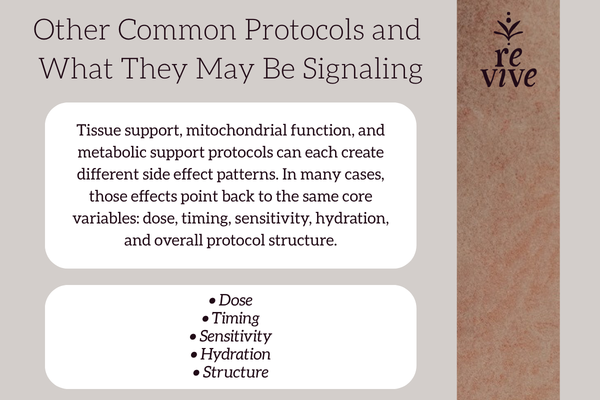
Some protocols create milder or more specific side effect patterns, but they still offer important insight into how the body is responding. Whether the goal is tissue support, mitochondrial function, metabolic output, or nutrient-based support, these compounds can still highlight when timing is off, dosing needs refinement, or the body needs a more supportive foundation. Understanding these smaller signals is often what leads to a smoother, more effective protocol overall.
GHK-Cu
GHK-Cu is often used for tissue remodeling and collagen signaling. Side effects are usually mild, but fatigue, topical sensitivity, or rare headaches can still point to a need for better timing or dose refinement.
SS-31
SS-31 is often used to support mitochondrial repair and efficiency. Mild headaches or temporary fatigue may reflect adjustment and shifting energy demands, especially early on.
SLU-PP-332
SLU-PP-332 may bring changes in hunger, mild jitteriness, or energy fluctuations depending on what it is paired with. This is a reminder that metabolic support still needs structure, not just stimulation.
Lipo-B/MIC-B
Lipo-B or MIC-B blends can create jitteriness, nausea, or acne in sensitive patients. These side effects often say more about food timing, sensitivity, or dosing frequency than about whether the blend is appropriate at all.
Red Flags That Mean It Is Time to Adjust
Not every side effect should be pushed through. Some signs tell you it is time to pause, reassess, or adjust immediately:
- Persistent headaches
- Ongoing nausea that continues beyond the early adjustment window
- Sleep disruption that does not settle
- Appetite suppression so strong that protein intake drops too low
- Repeated dehydration, lightheadedness, or worsening fatigue
These are not signs to “work harder” or assume the peptide will eventually override the problem. They are signs that the protocol needs refinement.
The Revive Approach
At Revive With Me, we believe better outcomes come from better structure.
That means treating the person, not just the protocol. It means looking at recovery status, hydration, stress load, sleep quality, food intake, timing, and dose tolerance instead of only asking whether a specific compound is working.
Most side effects are not random. They are feedback. And when you understand that feedback, you can build a protocol that works with the body instead of against it.
Peptides do not fail on their own. Protocols fail when they are not built around the human using them.